
We know it can take some time to recover from the holiday season. All the shopping, meals, family visits, concerts, events, office parties, and finally New Year’s Eve (when we frankly don’t mind falling asleep by 10 PM!). Once the New Year rolls around, you just want some serenity. It’s deserved, but this downtime is also a great opportunity to address any stubborn foot or ankle problems you might be having. We encourage new patients to use the slower pace of winter as the time to improve the condition of your feet.
Some people go year after year living with pain from conditions such as plantar fasciitis, bunions, arthritis, and nerve damage. It just becomes “part of life” or is believed to be something that isn’t going to benefit from treatment. This is a way of thinking that not only robs you of your quality of life, but also can lead to problems growing even worse over time.
Even if a foot or ankle condition can’t be fully cured, there are many that can be managed to prevent further deterioration. These methods are often conservative, too. Surgery is not the only solution for bunions, for example. Orthotics and other measures can help many patients lead more comfortable lives without removing the protrusion.
There is no better time than now to find expert help for the foot, ankle, and heel pain that has been plaguing you for so long. The office of Dr. Kevin Powers is happy to accept new patients from Bloomington, Bedford, and surrounding areas. We even have our registration form available to download and fill out before your first visit, to save you time in the waiting room and allow us to get help to you all that much faster! Call us at (812) 333-4422 to schedule an appointment today and take the first new steps toward a better outlook for your feet.
Some things go together well, like New Year’s Eve and a room full of loved ones. Whether you plan to spend the evening with comedian Tom Brady (not the NFL quarterback!), attend the Kid Kazooey Family Dance Party, or just have a traditional gathering at home, it will be hard to go wrong. There are other pair-ups, though, that aren’t worth celebrating at all. Diabetes and peripheral arterial disease (PAD), for example, are a tag team of big trouble.
If you have diabetes, odds are higher that you’ll have PAD as well. This condition causes a narrowing or gradual blockage of blood vessels over time, and having too much blood sugar can weaken the vascular system and make it more susceptible to narrowing.
That’s not the only peril of their partnership, however. When their effects combine at foot level, it can be a recipe for serious danger. How?
The course of diabetes can lead to nerve damage, or neuropathy, as well. This is often experienced in the feet as a lessening or loss of sensation. As circulation decreases from peripheral arterial disease, it can lead to wounds and sores taking much longer to heal, or not healing at all. So, if a cut or sore develops on the foot and goes unnoticed due to neuropathy, it can remain open for a long time due to poor circulation. If not caught in time, this can leave the foot wide open to a serious infection. Many feet, sadly, are lost to amputation this way every year.
If diabetes and/or PAD are concerns when it comes to your health, it’s crucial to consider your feet as part of your efforts to manage these conditions. Check your feet every day for signs of damage or abnormalities, and have an expert in your corner for when something does come up. Call the office of Dr. Kevin Power at (812) 333-4422 or contact us using our online form. Our Bloomington office will be happy to schedule an appointment for you or address any questions you may have.
The weather we’ve seen through the past couple months might make it a more favorable year than most, but it should still be a chilly time at the 12th Annual Bloomington Polar Bear Plunge on Jan. 1! Participants might feel like their blood is freezing solid, but a run into the waters of Fairfax Beach should actually get those heart rates up! We’re not saying you should become a polar bear plunger if you want to fight poor circulation peripheral arterial disease (PAD), but a more active lifestyle can certainly help.
For many with PAD, getting active can be a painful proposition. This is due to intermittent claudication, a cramping sensation in the legs when they don’t receive enough oxygen from the blood to keep up with demand. However, although the pain might make you think it’s best to stop, the situation will actually improve as you continue a program. Your body begins to adjust to working with less oxygen from your narrowed blood vessels and adapts to what it gets. How amazing is that?
You don’t even have to engage in serious cardio to start improving. An organized walking program has been shown to be effective in many suffering from PAD. It might take some patience, but gradually you’ll be able to travel longer distances without pain cutting the trip short. The keys are to take it steady and not become frustrated with yourself. It’ll be worth it, we swear!
There are other lifestyle changes one can make to fight back against the effects of peripheral arterial disease, such as quitting smoking and controlling cholesterol. For more advice on how to improve the health and comfort of your feet with poor circulation, contact the office of Dr. Kevin Powers at (812) 333-4422 or fill out our contact form. We’d be happy to take the plunge with you!
Mary Poppins should be a pleasant performance to take the family to this season. It’s performing at the Buskirk-Chumley Theater from Dec. 18-23! Everyone’s favorite nanny knows how to make life better, and her friend Bert knew the importance of keeping a chimney passage clean from buildup. A narrow chimney can create hazards to a home, and such is the same with poor circulation and our feet.
The circulatory system is the body’s way of distributing oxygen and nourishment for all its parts to function properly. When peripheral arterial disease (PAD) or another condition cause the blood vessels to become clogged or narrowed, it’s similar to blocking off lanes on a delivery route. Things are not going to get where they need to be as quickly, and this can have consequences.
Although the effects of poor circulation can be felt in many parts of the body, and especially the legs, there are a few signs one can look for in the feet as well. You might feel coldness in an affected foot compared to one that might have a better blood flow. A loss of hair on the foot or a slower growth of toenails might also be noticeable, since not enough nourishment is being received to maintain the follicles and nails.
These problems may seem relatively minor, but they can be a warning of worse problems down the road. Cuts and sores on the foot may no longer be able to heal properly under poor circulation, which could lead to a deterioration of the foot or a serious infection.
If you see signs of poor circulation in your feet—especially sores that are slow to heal—you should consult a professional. Dr. Kevin Powers is here to serve the foot and ankle needs of patients in Bedford, Bloomington, and all surrounding areas. Scheduling an appointment with us is easy; just call (812) 333-4422.
We know: there’s already plenty to be done for the holidays before winter rolls around. You could have decorating, lights, family dinner planning… maybe you might even get the kids into their PJs and hop over to the Pajamborie! At Fountain Square mall Dec. 15. In all the coming rush, though, it can pay to take a moment to consider your feet and the effects an Indiana winter can have on them. Performing some winter foot care can keep your feet looking and feeling great well into the new year.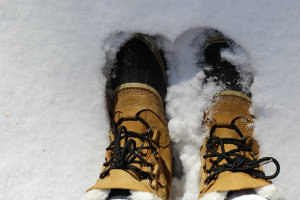
First, let’s consider footwear. Boots are sometimes a necessity when it comes to our icy Indiana conditions, but the combo of waterproof material and warm socks can lead to a lot of sweat. Soaked feet are more prone to fungal and bacterial infections, so consider using foot powder inside your socks and shoes and clean your feet a little more frequently if boots are a go-to.
Whatever you choose to wear outside, at least make sure it’s appropriate for your plans and any problems that might arise. You don’t want to get caught slipping on icy pavement in plain sneakers or pumps. It’s a guaranteed ticket to misery, and you can even risk a case of frostbite!
When not worrying about sweat, you might actually have to worry about your feet being too dry! Heated, dry rooms can cause a loss of moisture, and excessively hot showers and baths can also strip moisture away from your feet. Counteract this attack by moisturizing your feet after bathing. Mild, alcohol-free ones tend to be best, but go for whichever leaves your feet feeling satisfied.
And, of course, if any problems arise with your feet or ankles this winter, get them checked out! Bloomington podiatrist Dr. Kevin Powers is here to keep your feet in top condition no matter the temperature. Schedule an appointment with us by calling (812) 333-4422.
By the time you’ve reached your senior years, your feet have likely taken quite the journey. The average 80-year-old will have taken well over 200 million steps, and most assuredly not all of them were easy. Aging feet have born a lot of wear and weight through life, so it’s important to take special care of them.
Time can have a detrimental effect on feet. They tend to lose their cushioning, and nails can grow brittle. It is also quite possible that the stiffness of arthritis has set in, or that poor circulation has made it so sores heal more slowly. This is why it’s so important to keep a regular eye on the conditions of aging feet. Look for injuries, blisters, ingrown nails, or any other abnormalities. The use of a mirror or loved one may be needed to be able to see everything, but it’s worth it.
Seniors should often try to aid circulation in their feet. Engaging in more physical activity such as walking or swimming will naturally help, and so can putting one’s feet up while sitting down or receiving a foot massage. Any smoking should stop immediately, as that only contributes to the buildup of plaque in blood vessels.
Properly fitting shoes is another must. Some seniors tend to procrastinate on buying new shoes, but the sizes of their feet can still change over time. Make sure a foot measurement has been performed recently, and choose shoes that are comfortable, accommodating, and prevent slipping.
With proper care, aging feet can continue strong into life’s journey. For any problems or needs that may arise, Dr. Kevin Powers in Bloomington can provide thorough, considerate treatment and advice. Schedule an appointment for yourself or a loved one by calling (812) 333-4422.
The end of the year tends to be a season of gratitude; not only with Thanksgiving but in all of our other gatherings with friends and family as well. Something that might get forgotten in all the bustle are the things that get us to these warm gatherings. It’s especially during busy times, however, that we should be paying extra respect to our feet—especially if we live with the effects of diabetes.
Daily diabetic foot care does not need to be complicated. For starters, make sure to wash your feet every day with warm water and a mild soap that agrees with your skin. Soaking your feet is not recommended, thought, as it might cause the skin to break down and open your feet more to infection. In fact, be sure to dry your feet thoroughly after bathing them, paying special attention to where water can gather between the toes.
Drying your feet is also a great time to get into the habit of a daily inspection. Check the tops and bottoms of your feet for any signs of injury or trouble, such as cuts that aren’t healing, blisters, or dry skin. A moisturizing lotion can help with dryness, but check in with a professional about any other problems.
You can also pamper your feet with protection. Invest in comfortable, well-fitting shoes that don’t need to be broken in and don’t rub against any part of your feet. Nice, warm cotton or wool socks can also provide additional covering when walking around at home.
Showing gratitude for the small things about your feet can help prevent big problems down the road. Bloomington podiatrist Dr. Kevin Powers can serve in your corner when it comes to comprehensive diabetic foot care, providing expert care and advice to fit your specific needs. Call us at (812) 333-4422 to set an appointment with us today.
If you are looking for some new mittens or gloves for the coming winter, time is running out to pick up some locally crafted pairs at the By Hand Gallery. The gallery is showcasing warm apparel, also including scarves and hats, until Nov. 30. It’s a good way to take care of your hands, but what should you do if your feet are suffering from the pain and stiffness of rheumatoid arthritis? Is joint surgery the only good option?
In many cases, no. Some patients are able to manage the symptoms of rheumatoid arthritis through more conservative options such as custom orthotics, medications, and physical therapy. And if this is the case for you, it’s almost always preferred that one continue with these treatments instead of surgery.
However, some patients have cartilage damage that is just too extensive for other treatments to be effective, or conservative methods otherwise just don’t work. It is then when surgery becomes a consideration for relieving pain and restoring movement.
It must be noted that not all joints may be able to be surgically treated, and those that can are likely unable to return to full, normal function. But for the extent of mobility and relief joint surgery can provide, it may very well be worth it. This is something that must be discussed on a case-by-case basis, as multiple surgical options might be available.
When it comes to finding relief from rheumatoid arthritis, we believe in providing the best options for a patient based on his or her individual needs. For help with arthritis pain in your feet and ankles, contact the Bloomington office of Dr. Kevin Powers at (812) 333-4422.
The 27th Annual Indianapolis Jingle Bell Run/Walk is coming up on December 12th. It’s only a good hour away from Bloomington, and you still have time to plan your holiday costume, get jingle bells for your shoes, and help Rheuby the Reindeer have some holiday fun.* You’ll be supporting a good cause, too: raising funds to cure rheumatoid arthritis (RA).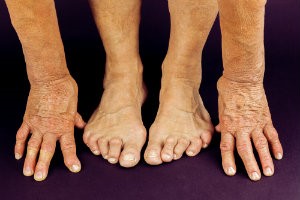
The disease is insidious, making your body think the linings in your joints are an enemy that needs to be destroyed. Most people who get it will have problems in their lower limbs at some point. We’ll take you on a point-to-point tour to explain.
Toes. RA causes 3 main problems in this area. 1) The joint lining where the big toe joins your foot becomes inflamed and the joint deteriorates, leading to a painful bunion. 2) Your smaller toes can become dislocated and curl up into hammertoes that press against the tops of your shoes and develop sores. 3) The degraded joints allow the metatarsals to push down against your shoes, causing bumps, calluses or ulcers, and metatarsalgia (forefoot pain).
Mid-Foot. With this form of arthritis, the tendons and ligaments that hold your arch in place can become weak and the arch collapses. The inner edge of the foot lowers, the toes point out more, and eventually the joints where the long bones and midfoot bones meet move out of position, causing a visible bump along the arch.
Heel Area. As the foot structure continues to collapse, the heel leans over and it becomes difficult and painful to walk on uneven, stony, or unstable surfaces (like grass). The tendons and ligaments are painful when overstretched, too.
Ankle. When RA reaches this area, pain from your weight on the joints make it difficult to walk on stairs or ramps, or eventually even to walk or stand at all.
There are many things we can do to help alleviate the swelling, stiffness, and pain of arthritis in feet. Please call Kevin Powers, DPM at 812-333-4422 when you first notice the symptoms and schedule an appointment at our Bloomington, IN office. We also welcome patients from surrounding cities like Kirby, Woodbridge, Harrodsburg, and Bedford, IN. You can set up an appointment using the form on our website.
*For more information, go to http://docs.afheartland.org/JBR/2015JBRIndy-Rheuby.pdf, print a picture of Rheuby, and take selfies with her at fun places you go.
Thanksgiving is coming soon, and most who celebrate this day will have a warm, fulfilling meal with their families—some of whom they might not have seen all year! For some families with more strained ties, however, this holiday can turn into an evening of quarreling that leaves everyone feeling trapped and miserable. Those who suffer from rheumatoid arthritis in their feet or ankles know how awful in-fighting can be, as they may experience this every day in their joints.
Unlike osteoarthritis, which develops through mechanical “wear and tear” against the joints over time, rheumatoid arthritis (RA) is an autoimmune disease. The body’s own defenses begin to attack healthy tissue. This can happen just about anywhere on the body, but here we’ll focus on the ligaments and cartilage surrounding joints in the feet and ankles.
As an effect of RA, the protective lining that surrounds joints—the synovium—becomes overactive and inflamed. This gradually ruins the joint and damages the other tissues surrounding it. As ligaments weaken in the feet, deformities such as bunions and hammertoes can develop.
While there is currently no cure for rheumatoid arthritis, there are ways to help relieve the pain, stiffness, and discomfort associated with it. Treatments range from conservative methods to various forms of surgery, depending on the severity of the damage and needs of the patient.
For help with managing rheumatoid arthritis pain in your feet, contact the office of Dr. Kevin Powers. Serving Bedford, Bloomington, and the surrounding area, we will find the best ways to relieve discomfort and increase your quality of life. Schedule an appointment by calling us at (812) 333-4422 or contact us online.


